• When Back Pain Meets Heavy Packages

    December 2023, just two days before Christmas, I was in a car crash that left me with lasting back pain. Since then, lifting heavier packages has been a daily struggle. Quick lifts aren’t terrible, but the real challenge comes when I have to carry a 40+ lb package from my car to the customer’s doorstep. The farther I walk with that weight, the higher the risk of re-injury — and it magnifies the pain I live with every day.

    The Chaotic Reality of Delivery Day

    Quality wagons and hand carts are great… until a customer’s dog decides your cart is the perfect opponent. Suddenly, that trusty wagon becomes a sacrifice when Cojo is on your heels.

    One day, Cojo decided the seat of my pants looked extra tasty. I let go of the cart, ran like hell, climbed the nearest tree and mentally cued the Lion King 2: Simba’s Pride soundtrack. Customer found themselves somebody to chase Amazon up a tree… the battle may be bloody — that doesn’t work for me.

    Oh, and of course, when your metrics get penalized after a loose dog incident, you can’t help but think either they messed up or didn’t fully believe you — that’s just the reality of gig work.

    Practical Tips for Carrying Heavy Packages Safely

    1. Invest in a durable hand cart or wagon
      • Choose one rated for 40+ lbs or more. The wagon I’ve used was helpful for a while, but it’s falling apart now. Instead of showing you a poor-quality item, I’ll show the one I want to try next — built to last.
    2. Lift safely
      • Bend at the knees, keep the package close to your body, and avoid twisting.
    3. Plan your route
      • Minimize distance from car to doorstep whenever possible to reduce strain.
    4. Manage daily back care
      • Stretch, ice or heat, and pace yourself during shifts.
    5. Know your limits
      • Even with tools, avoid carrying more than you can handle safely — your long-term health is more important than a single delivery (though amazon will undoubtedly disagree.)

    Takeaway

    Delivering heavy packages isn’t easy, especially with back pain or unpredictable chaos like loose dogs. The right tools, safe lifting habits, and a little humor can save your back — and maybe even your sanity. Small adjustments today can make a huge difference in your long-term health and gig work success.

  • How Gig Workers Can Treat Their Income Like a Real Job and Grow Wealth

                                                                                                       Introduction

    Within minutes of completing a shift, gig workers—like Amazon Flex drivers and DoorDash drivers—can access instant pay. That’s faster than most traditional W-2 jobs. Exciting, right? But easy come, easy go. Without planning and discipline, those earnings can disappear just as quickly.

    This post is for gig workers who want to take control of their income, save consistently, invest wisely, and even explore trading. While your work schedule might be flexible, treating your money with seriousness and structure can set you up for long-term financial growth.


    Discipline and Treating Gig Work Like a Real Job

    Gig work comes with freedom, but it also comes with challenges. Friends and family may assume you can “drop and go” anytime, ignoring the fact that your time is valuable. Protecting your schedule and earnings is crucial.

    I personally had to set firm boundaries with my family. Even during emergencies, I made it clear that my work and schedule were non-negotiable. Standing your ground isn’t unkind—it’s professional.

    Tips for Discipline:

    • Automate savings or trading contributions so you stay consistent without relying on willpower.
    • Separate “trading money” from money for bills and essentials.
    • Respect your time and earnings, just like a traditional job.

    Key Takeaway: Discipline + boundaries = predictable cash flow, which makes saving, investing, and trading possible.

    Not everyone will need or want the automated savings or trading but it’s definitely a handy feature those who do need or at least want it.


     Navigating Advice and Financial Skepticism

    Friends and family often discouraged me from investing in stocks or using high-yield savings accounts. Some spoke from personal experience; others spoke from witnessing others’ experiences. They swore banks couldn’t be trusted, and that stocks were too risky.

    Banks / HYSAs:

    • Many banks are safe if you track accounts carefully.
    • Keep a transaction register for each account and reconcile regularly—don’t rely solely on mobile apps.

    Stocks:

    • Stocks aren’t guaranteed. Values fluctuate daily, and companies can fail.
    • Invest only what you can afford to lose.
    • Maintain a diversified portfolio, mixing dividend and non-dividend stocks.

    Healthy skepticism is good, but don’t let fear stop you from growing your wealth.


     Investing: Dividend Stocks & Fractional Shares

    Dividend-paying stocks are an excellent way to earn passive income. Dividends are typically paid quarterly, and the amount you earn is proportional to how many shares—or fractional shares—you own.

    Fractional Shares:

    • A portion of a full share.
    • Allow you to invest smaller amounts and still earn dividends.

    Why Dividends Matter:

    • You earn dividends even if the stock’s market price drops.
    • Avoid panic selling during dips—these are normal and often recover.

    Tip: Reinvest dividends to take advantage of compound growth over time.

     Investing: Non-Dividend Stocks

    Non-dividend stocks can also be beneficial, often focusing on growth rather than payouts.

    Strategy:

    • Buy during price dips and sell when the stock rises.
    • Only invest money you can afford to lose; nothing is ever 100% guaranteed.
    • Treat non-dividend stocks as part of a diversified portfolio.

    Tip: Avoid panic selling during temporary dips—long-term trends matter more than short-term fluctuations.


    High-Yield Savings Accounts (HYSA)

    Not every dollar needs to be at risk. HYSAs offer a safe place to store money while earning interest above the national average—often much higher than traditional savings accounts.

    Why HYSAs Matter:

    1. Compounding: Interest is often compounded daily and paid monthly. Your earned interest then generates more interest.
    2. Accessibility: Unlike CDs, your money remains accessible.
    3. Tracking: Platforms like Wealthfront show daily earned interest, helping you stay motivated.

    Account Recommendations (from experience):

    • Wealthfront: Daily interest tracking; monthly reset.
    • Jenius Bank: Slightly higher interest; no daily tracking.
    • EverBank: Higher interest than Wealthfront; no daily tracking.


    Tip: Maintain 2–3 HYSAs to maximize interest earnings. Even small contributions from gig earnings can grow significantly over time.


    . Common Mistakes to Avoid

    • Spending all instant pay without budgeting.
    • Trading impulsively based on “hot tips” or emotions.
    • Letting friends/family disrupt your schedule.
    • Mixing trading, savings, and emergency funds.


    Resources for Continued Learning

    • Books, YouTube channels, or online courses on trading and investing.
    • Stock market news and analysis platforms.
    • Communities for gig workers focused on finance and investing.


    Conclusion

    Gig work is real work, and your income deserves respect—both from you and those around you. Instant pay is powerful, but discipline, boundaries, and planning are crucial. Start small, protect your time, save consistently, and invest wisely. Over time, your gig earnings can become a tool for long-term financial growth.

  • When the App Blames You for Its Own Mistakes

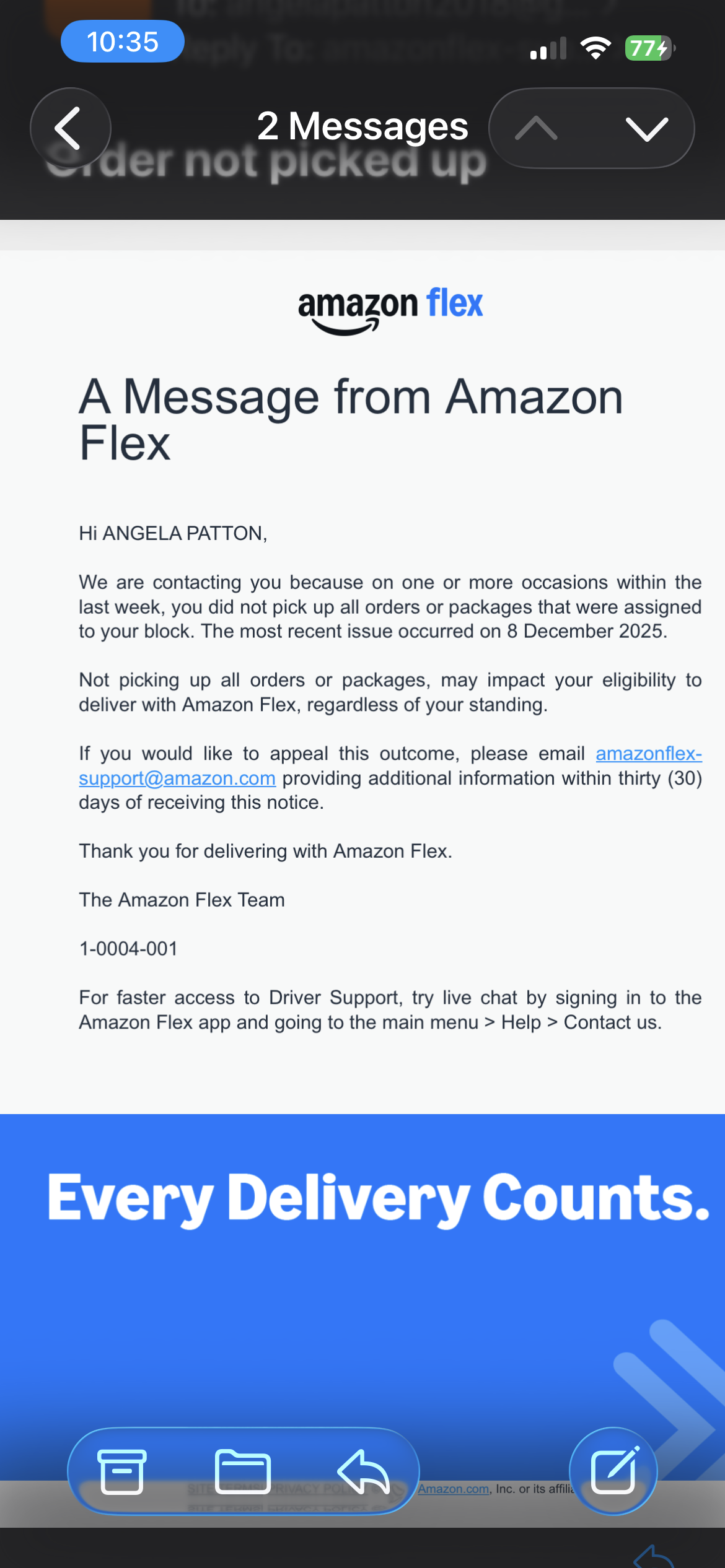
    Amazon Flex recently sent me an alarming email claiming I hadn’t picked up all my assigned orders. Let’s break down exactly what happened — with screenshots, timestamps, and support interactions — so readers can see how policy vs reality can diverge when system errors are treated as driver fault.

    Stage 1: The App Glitch – A Second Pickup That Wasn’t Mine

    Caption: “These packages with a diagonal line pattern were never assigned to me — the system added them erroneously.”

    While en route on my accepted block, the app attempted to route me from Middleburg to DCM3 (Solon). Amazon Flex blocks are designed with:

    • A single pickup location
    • A single acceptance event
    • No second pickup unless the driver explicitly accepts it

    I never accepted a second pickup. Yet the system behaved as if one was assigned.

    Additionally, several packages associated with this endpoint showed a diagonal line pattern, which means they were not truly assigned to my route — something other drivers also recognize as a glitch indicator within the app.

    This clearly demonstrates a backend assignment error — not driver omission.


    Stage 2: The Confusing Appeal Response

    a picture taken during chat with amazon flex support to prove what was actually said
    The email from Amazon flex claiming I did not pick up all packages assigned to my block

    Because the app behaved abnormally, I contacted Amazon Flex support and later submitted an appeal with screenshots. However, their email response said the incident would remain in my delivery history without specifying which issue they meant.

    During a support chat the next day, the agent confirmed:

    “It was for the ONP appeal… I have escalated the issue again.”

    This confirmation ties the ONP to the December 8th glitch — a glitch I did not cause and did not accept responsibility for — yet the appeal response left the record unchanged.

    Stage 3: Disregard for Facts Meets Policy

    (I know I have the same screenshot twice but that’s because it is important to this portion as well.)


    The email stated:

    “Not picking up all orders or packages may impact your eligibility to deliver with Amazon Flex, regardless of your standing.”

    However, Amazon’s own published guidance about standings describes a very different intent. The standings system is supposed to reflect a driver’s recent delivery history, and it considers factors outside a driver’s control — such as station delays, traffic, or weather — when evaluating performance. 

    Here are official links showing Amazon’s policy and standings concept:

    🔗 Amazon Flex Blog – Using Standings to Succeed

    ☞ https://flex.amazon.com/blog/2024/using-standings-to-succeed-with-amazon-flex

    🔗 Amazon Flex FAQ – Standings

    ☞ https://flex.amazon.com/faq

    These links show that:

    • Standings are meant to inform and guide drivers
    • They’re based on recent delivery history
    • Performance considerations include circumstances outside the driver’s control  

    Yet in my case, a system error that forced a second pickup resulted in an ONP email that treats the glitch as driver fault — despite documented evidence proving the issue was technical, not behavioral.

    Even though the email felt personal, it’s likely a systemic failure rather than anything targeted at me personally. That said, the timing couldn’t have been worse: on Friday, December 12th, I was rear-ended by another motorist — who, coincidentally, was transporting an Amazon employee to the same fulfillment center I was headed for — adding stress in an already confusing situation.

    Despite it all, I stayed professional, documented everything carefully, and followed the proper processes.

    A Note on Timing and Standing

    It’s important to note that this incident occurred just after my standing improved to Fantastic — which accurately reflected my real performance history. The improvement came before the app-generated glitch that led to this erroneous ONP.

    In other words:

    • My standing was improving based on actual performance
    • The glitch occurred after that improvement
    • The ONP resulted from a system error — not driver action

    That sequence highlights how Amazon’s systems can create issues that contradict their own stated policy and performance metrics.

    Conclusion

    • A second pickup was added by the system, not accepted by me
    • The app attempted to route me to an unassigned location
    • Support later confirmed the ONP applied to the Dec. 8 glitch
    • Amazon’s email contradicts both their documentation and the real evidence

    I stayed professional, collected all the evidence, and am prepared for escalation or arbitration if necessary 😈 — because when the system fails, accountability matters.

    For additional context on ongoing metrics and standings inconsistencies, see my previous posts:

    And there you have it — Amazon’s own policies, glitches, and selective enforcement, all documented for the world to see. At this point, they might want to call a backhoe for the hole they’ve dug. 

    😏


  • Sometimes professionalism wins. Sometimes sarcasm wins. Sometimes both can live happily together — with screenshots as proof. 🙄

    There was a time when my response to corporate nonsense would’ve been fast, fiery, and decorated with at least one middle-finger emoji.

    This was almost one of those times.

    After yet another app issue that absolutely was not my fault, I paused before emailing support — not because I wasn’t angry, but because I’ve learned something important:

    The moment you sound emotional, the problem stops being the problem.

    So instead of sending the email I wanted to send, I sent the one that protects me.

    And that matters — especially when metrics are involved.

    According to Amazon™️…

    “Standings help delivery partners understand their recent delivery history and identify opportunities to improve.”

    — Amazon Flex Blog: Using Standings to Succeedhttps://flex.amazon.com/blog/2024/using-standings-to-succeed-with-amazon-flex

    Helpful. Supportive. Educational. Inspiring. The sort of motivational stuff you’d expect from a company that can convince the system that my packages vanished into thin air.

    🙄

    How the app actually behaved

    I arrived at my station, followed the app’s instructions exactly, and scanned every single package on my assigned route.

    The result?

    Every package on my route was instantly marked “missing.”

    No explanation.

    No warning.

    No suggestion on how to “improve.”

    Just a system error confidently declaring: Angela, your packages are missing. You are now subhuman.

    When I contacted Support, I was given two options:

    • Mark all packages delivered (they were not)
    • Mark the route rejected (I did not reject it)

    Either option would have negatively impacted my standing for something entirely outside my control.

    So much for “learning opportunities.” If this were a real school, I’d have detention for being too competent.

    For context, I wrote about how they “fixed” the fake DNR but replaced it with a fake late — because apparently, errors like this evolve faster than Pokémon.

    Metrics in theory vs. metrics in reality

    Amazon’s own materials suggest standings are a fair, transparent reflection of driver behavior. You can read their description here.

    Yet in reality, drivers are expected to:

    • Navigate app glitches
    • Interpret conflicting instructions
    • Absorb system errors
    • And then calmly “improve” based on inaccurate data

    Patterns like this aren’t new — I’ve documented them before in “Standing Wars: The Battle for Accurate Metrics”.

    These aren’t isolated incidents. They’re patterns. Patterns that apparently teach the very important life skill: how to argue with your phone.

    What exactly is the lesson here?

    If standings are meant to help drivers improve, I’d love clarification on what improvement looks like in situations like this:

    • Don’t scan when the app tells you to?
    • Ignore what the system displays?
    • Accept metric damage quietly and hope it disappears later?
    • Or escalate repeatedly just to correct Amazon’s own data?

    Because none of those are improvements.

    They’re coping mechanisms.

    Coping mechanisms that involve equal parts patience, screenshotting, and small amounts of muttered profanity.

    Why I didn’t send the angry email

    I didn’t hold back because Amazon “deserved” politeness.

    I held back because professionalism is leverage.

    Anger feels good for about 30 seconds.

    Documentation protects you for months.

    Sarcasm lives here — in this very blog — where it can laugh at the absurdity without negatively impacting my standing.

    I paused.

    I removed the snark.

    I attached screenshots.

    I stated facts.

    And I made sure the paper trail reflected reality — not marketing language.

    Final thoughts (with extra spice )

    If standings truly exist to help drivers succeed, then accuracy shouldn’t require screenshots, escalation, or legal-adjacent language to achieve.

    And if professionalism is required from drivers at all times, it would be nice to see the same standard applied to the systems evaluating us.

    Until then, I’ll keep doing what veteran drivers learn to do best:

    • Document everything
    • Stay calm in writing
    • Argue with the app silently in my head
    • And save the eye-rolls for the blog 🙄

    Because let’s face it: the only thing standing between me and total chaos is my wit, my screenshots, and my impeccable taste in sarcasm.

  • Let’s cut the crap: gig apps don’t care about you. Uber, Lyft, DoorDash—they don’t care that you’ve memorized every shortcut, that you defended yourself against a crazy customer, or that your car smells like a fries-and-sadness combo. They only care about customer satisfaction—and your ratings. Everything else? Meh.

    So if you want to survive this nonsense, here’s how to make your money and hustle untouchable, and maybe have a laugh while you’re at it.

    1. Never Rely on Just One App

    One app? One disaster waiting to happen. They’ll deactivate you faster than a bad Tinder date. One minute you’re stacking orders, the next you’re left staring at:

    “Your account has been deactivated.”

    Rule: Always have at least two gigs. That way, if one app nukes you for some random algorithmic reason, the other keeps your bills paid and your caffeine addiction alive. Survival tip: diversify or cry.


    2. Your Money, Your Rules

    Here’s a nugget most gig apps won’t tell you: they don’t care what you do with your money. Your savings? Your investments? Your dividend payouts? None of their business.

    Take control:

    • High-yield savings accounts (like Wealthfront). Interest accrues daily, compounds, and pays monthly. That “chump change” grows quietly like a passive-aggressive coworker you can’t fire.
    • Fractional shares via Cash App. $1 buys stock; dividends start trickling in. Small but mighty.
    • CDs, annuities, or other boring-but-safe investments. The apps can deactivate you, but they cannot touch your money once it’s doing its thing.

    3. Emergency Fund: Your Armor

    Even a few hundred dollars tucked away can prevent a gig-induced panic attack. Treat it like a bulletproof vest against algorithmic betrayal.


    4. Document Everything

    Screenshots, notes, delivery logs—keep everything. Customers lie. Apps get shady. You need receipts like a detective needs a notebook. Bonus: this material makes excellent snarky blog content later.


    5. Budget Like a Boss

    Know your essentials: bills, groceries, gas. Make them untouchable. Everything else? Optional. When the apps inevitably de-platform you, you’re still covered. Meanwhile, the apps are over there like:

    “Uh… she’s fine?”

    Yes. She’s fine.


    6. Make Every Dollar Work

    Stop letting the apps control your life. Start making your money work for you:

    • Cash App investing: Fractional shares, dividends—even $1 counts.
    • Dividend strategy: Set up your portfolio to collect payouts every month, not just quarterly. Passive income, baby.
    • Low-risk picks: Major phone companies, retailers you actually shop at (hello, Walmart), and energy companies like AEP and First Energy.

    Let’s be real: as long as humans need electricity, energy companies exist. Your monthly bills? You’re basically taking some of that money back through dividends. Laughs in passive income.

    • Stocks go up and down daily—don’t panic-sell. Most recover. The ones that don’t? Cut ’em before they take your entire investment with them.

    7. The Mindset Shift

    This is the real power move:

    From: “I’m at the mercy of the apps”
    To: “Test me and find out.”

    Algorithms? Customer ratings? Mysterious deactivations? Irrelevant. Your investments and diversified income make you untouchable.


    8. Keep Grinding, Keep Growing

    Slow, steady, and intentional. Keep saving, keep investing, and let your money work while you hustle. Eventually, your wallet will thank you—and the apps will just sit there wondering why you’re not panicking.

    Multiple gigs, emergency fund, high-yield savings, Cash App fractional shares, dividend strategy, low-risk stocks, budgeting, documenting everything, and the “test me” mentality = surviving the gig economy with your sanity and your bank account intact.

    Mic drop.

  • (Because of course they did.)

    So Amazon finally removed a fake DNR from my standings.

    🎉
    🎊
    👏

    And almost immediately?

    They added one single “late delivery.”

    Not multiple.

    Not a pattern.

    Just one.

    Because apparently the algorithm said, “Oh no, accountability was restored. We can’t have that.”

    The Amazon Standings Shell Game

    If you’ve been delivering long enough, you already know the move:

    • You dispute a false issue
    • Amazon agrees it was wrong
    • Your standings improve
    • Suddenly—surprise!—a brand new issue appears

    Different label.

    Same energy.

    It’s like playing whack-a-mole, except the mole is imaginary and the mallet is your livelihood.

    Let’s Be Clear: One Late ≠ A Problem

    One late delivery does not mean:

    • You’re unreliable
    • You’re careless
    • You suddenly forgot how to do your job

    It usually means:

    • Traffic
    • Weather
    • App routing nonsense
    • A stop sequence that defies physics
    • Or my personal favorite: “Arrive at 9:59 PM. Deliver by 9:58 PM.”

    But instead of acknowledging reality, the system quietly swaps one fake issue for another and calls it balance.

    Why This Matters (And Why I’m Side-Eyeing It)

    I don’t care about perfection.

    I care about patterns.

    And the pattern is this:

    • Remove one false mark
    • Add a different one
    • Keep drivers in a constant state of “almost good enough”

    Not bad enough to clearly fight.

    Not clean enough to feel safe.

    That’s not quality control.

    That’s pressure management.

    What I’m Doing (And What You Should Do Too)

    No panic. No rage emails. No unhinged appeals.

    Just:

    • Screenshot everything
    • Track dates and times
    • Note when issues are removed and when new ones appear
    • Treat every “minor” issue like documentation for later

    Because today it’s “just one late.”

    Tomorrow it’s “a trend.”

    And we all know how fast that story gets written.

    Final Thought (With Love and Side-Eye)

    Amazon fixing a fake DNR is good.

    Amazon immediately adding a fake late is… predictable.

    I’ll keep delivering professionally.

    I’ll keep documenting carefully.

    And I’ll keep calling out nonsense when I see it.

    Because if they’re going to play games with standings, I’m at least keeping score. 😏

    Leave a comment and tell me about your Amazon standing wars.

  • (And Shut Down Fake Metrics Once and For All)**

    Amazon drivers get blamed for a lot of things that aren’t their fault — fake “Delivered Not Received” claims, wrong-location accusations, GPS inaccuracy, pin errors, and app glitches that don’t track movements correctly.

    If you’ve ever been penalized over something you KNOW you did right, this guide is for you.

    This post teaches you how to document everything, escalate properly, protect your standing, and — if necessary — use arbitration the correct way. When drivers use these methods consistently, Amazon can’t touch them. Period.

    1. Why Documentation Is Your Shield

    Amazon will ALWAYS side with “the system” or the customer unless you have stronger proof.

    Your job is to make your documentation more reliable than Amazon’s flawed metrics.

    Photos

    Screenshots

    GPS proof

    Customer instruction captures

    Timestamps

    Address verification

    When you document correctly, you create a paper trail Amazon cannot argue with — and absolutely cannot penalize without exposing their own errors.

    2. Core Documentation Every Driver Should Do

    A. Delivery Photos — Don’t Skip These

    • Always take clear photos
    • Make sure the address, house features, or customer-specific markers show
    • If mats or décor change, match structure or surroundings instead

    Photos do not lie. Customers do.

    B. Screenshot GPS / Pin Before You Submit

    Sometimes the GPS lags. Sometimes the pin doesn’t update even when you’re literally standing on it.

    Take the screenshot first, then submit the delivery.

    C. Screenshot Customer Instructions

    If a customer says “leave it behind the garage,” and they later claim it was wrong?

    You have proof.

    D. Address Verification Photo

    Hold the package in view of the house number, mailbox, unit, or door label.

    E. Timestamp Everything

    Your phone automatically saves timestamps — let that work in your favor.

    3. Proactive Route Documentation (Your Best Defense)

    Whether there’s an issue or not, you should document every route.

    Why?

    Because when Amazon tries to claim you made a mistake, you already have:

    • Photos
    • GPS screenshots
    • Customer note captures
    • Address photos
    • A time-organized trail of correctness

    For drivers getting hit with fake DNRs or false “wrong location” claims, this method literally forces Amazon to back down.

    This is how drivers win.

    4. How to Email Documentation (The Smart Way)

    If you need to email Amazon:

    • Send one email per route, not per stop
    • Attach all relevant photos
    • Keep your tone factual, not emotional

    Template:

    Subject: Route Documentation – [Date] – [Route ID] (generally the date and start time time of the route will suffice.)

    Attached are delivery photos, GPS screenshots, and customer instruction captures for each stop on my route.

    I am sending these individually to ensure clarity and prevent communication errors.

    Please review if any inaccurate penalties appear on my standing.

    This approach is clean, organized, and impossible for Amazon to dismiss.

    5. GPS / Pin Inaccuracy: How to Protect Yourself

    When the pin is wrong or the GPS lags:

    1. Screenshot the map showing your blue dot on the location, even if the pin is off
    2. Screenshot the customer address
    3. Take the delivery photo
    4. Only after that should you submit the delivery

    The order matters.

    Your screenshot becomes proof the app was wrong — not you.

    6. Case Study: How This Method Beat Multiple Fake DNRs

    Drivers have successfully wiped entire clusters of false DNRs and wrong-location dings simply by proving:

    • All deliveries matched customer instructions
    • GPS was inaccurate
    • They documented every route
    • They sent everything one route at a time
    • They kept every email, ticket number, and timestamp

    In one case, Executive Relations removed every fake DNR after reviewing route-by-route documentation.

    This is what real evidence does.

    7. When (and When NOT) to Threaten Arbitration

    Arbitration is the nuclear option — powerful, but only if you don’t misuse it.

    Use arbitration ONLY when:

    • Support ignored you
    • Executive Relations ignored documented proof
    • The penalty is clearly false
    • You have airtight evidence

    DO NOT use arbitration threats for:

    • Minor issues
    • Cases where you lack documentation
    • Everyday frustrations

    If you threaten arbitration too often, it loses its punch.

    Proper Arbitration Wording:

    “If this penalty is not corrected, I will be forced to pursue formal arbitration.

    I have full documentation prepared for review.”

    Calm. Clear. Confident.

    Not emotional.

    Not angry.

    Just factual.

    Arbitrators care about intent + evidence.

    If your purpose is clarity and truth, you’re safe.

    8. How to Escalate Properly (Do This in the Right Order)

    This part is critical.

    Step 1: Start With Regular Support

    • Go through the app
    • Report the issue
    • Get a support ticket ID

    Executive Relations often ignores emails without a ticket ID.

    Step 2: THEN Email Executive Relations

    Include:

    • The support ticket number
    • Photos
    • Screenshots
    • Route ID
    • Date
    • Clear explanation

    Step 3: Use Arbitration ONLY After Steps 1 & 2 Fail

    Arbitration is more effective when you can show:

    • You followed the chain of command
    • You were ignored
    • You documented everything

    When you follow this process, Amazon has no excuse not to fix their error.

    9. Final Notes (Driver Empowerment)

    When drivers learn how to document routes correctly and escalate problems the right way, Amazon cannot push fake metrics on them anymore.

    GPS errors, customer lies, and app glitches lose all power when drivers:

    • Keep evidence
    • Stay consistent
    • Follow the escalation chain
    • Use arbitration as a final hammer

    If enough drivers adopt these methods, Amazon will be forced to stop penalizing people unfairly — because the proof will always be on your side.

    You are not powerless.

    You are not at Amazon’s mercy.

    You can protect yourself — and win — every time.
  •  

    I started the day mentally preparing to face Amazon, Mother Nature, and literally every brainless driver on the roads. The wind was already auditioning for WWE, shoving my car around like it was a prop in a slapstick comedy. Roads were dry at first, snow teasing me in the distance like it had RSVP’d to this nonsense. I braced myself. This was going to be a test.

    Route One: Picked up five packages. Calm at first—suspicious calm, because nothing is calm on these routes. The first few stops were smooth. Roads mostly dry, snow light, wind gusts pushing my car just enough to remind me it was alive. At one point, a gust shoved me left and then right; I eased off the gas and tightened my grip like a cage fighter.

    The final stop? Oh, I couldn’t resist a little smart-assery and delivered a package under the customer’s Christmas tree on the porch. Cue chuckles and a smug little victory dance from me. But calm? Don’t make me laugh. Wind picked up again, snow started lingering on my windshield longer, and I knew the storm wasn’t over yet. Visibility still good, but you could feel it creeping in.

    Route Two: Ha. Calm lasted exactly two minutes. Then: traffic from hell. Drivers who apparently forgot how brains work. Gusts trying to shove me into other lanes. Trucks with flickering headlights that were plotting against my sanity. Snow began starting-and-stopping like it couldn’t make up its mind, heavier at times.

    Stop two featured a resident and a dog conspiring to startle me simultaneously. I calmly told the dog’s owner, “It’s okay, he’s just telling on me.” Triple startle: two for me, one for them. Highlight of the route, hands down. Oh, and let’s not forget holy steepest hill I’ve ever seen! My gut did gymnastics, and I somehow survived.

    Wind gusts became more frequent, random bluish-green flashes in the sky startled the hell out of me. Aliens? Weird lightning? Who knows. Whatever it was, I didn’t want to be near it. Snow continued, roads wet in patches, and the drivers…oh, the drivers. Middle-of-the-road idiots, tailgaters, speeders. I stayed calm, mostly, telling myself, if they want to throw caution to the wind, go ahead, I won’t.

    Route Three: Picked up a two-hour route with nine packages. Snow had started to settle, wind gusts picked up, wet roads, leaves everywhere, and the GPS cheerfully announces a Lake Effect Snow Warning. No shit, Sherlock. Internal monologue: Brighter headlights. Yes. Ultra-bright LEDs. Those flashing-bright assholes? They’re about to learn why you mind your own damn business.

    Stop one: minor snow, wind gusts nudging the car, slowed down to maintain control. Stop two: nerves spiking, 34 degrees outside, snowflakes bigger now, but visibility still good. Breathing exercises engaged. Stop three: small tree limb in the driveway. Moved it, muttering very un-Amazon-friendly language. Stop four: snow sideways, gusts threatening to steal your breath. But surprisingly, deliveries finished fifty minutes early. Victory tastes sweet.

    On the way home: gusts nudging my car left and right, traffic blocking exits, drivers treating the highway like a racetrack. I’m calm. I’m collected. Mostly. Temperature dropped to 33, icy patches possible. Every gust made me tighten my grip, but I was homeward bound. Bright decorations reflected off the fresh snow, pretty lights saving my sanity a little.

    Mother Nature tried. Amazon tested. Drivers failed. Me? I survived. I got home, ready for a three-hour hot bath, cozy pajamas, and a hot chocolate the size of my ego after surviving this nonsense.

    If this post made you laugh, relate, or clutch your steering wheel in shared trauma:
    👉 Hit Follow
    👉 Share with a fellow chaotic commuter
    👉 Drop your worst weather-delivery story in the comments — because trauma bonding is real and we’re doing it together

  • (Yes, this really happened. No, I don’t get paid enough for this.)

    Some delivery days are smooth.

    Some are a little weird.

    And then some feel like the universe spun a wheel labeled “Let’s Traumatize Her” and hit the jackpot.

    I had two routes that day.

    Both were beautifully boring. No overloaded carts. No Christmas-light trip wires. No packages that weigh more than a toddler with a grudge. I was vibing. I was peaceful. I thought, “Hey, maybe the holiday chaos is sparing me today.”

    The universe: lol oh honey you’re dreaming it’s time to wake up now.

    The Final Stop From Hell

    Everything went off the rails at the very last stop of the second route.

    I walk up to the door like a functional adult just trying to deliver a package. The door opens and—

    THIS MAN IS ASS-OUT NAKED FROM THE WAIST DOWN.

    Late. November.

    Wind chill doing unspeakable things to his dignity.

    I immediately blurted out the only thing my brain could generate:

    “I can’t see anything, I don’t have a magnifying glass — go put some pants on, dirt bag!”

    His face…

    His FACE.

    He didn’t know whether to laugh, cry, or call for emotional support.

    He just stood there, frozen, like he suddenly remembered the temperature and all his life choices at once.

    I turn to leave before he can traumatize me further and then—

    from somewhere nearby—

    I hear a sound.

    Not a normal sound.

    Not a “cat meowing” sound.

    Not even a “fox yelling” sound.

    A sound like a cat being ripped to pieces.

    Straight-up horror movie audio.

    My fight-or-flight instantly chose violently flight.

    And Then… the Clown

    I’m speed-walking away, heart already in mid-panic, when out of the corner of my eye I catch movement. I look over toward the customer’s car and—

    THERE IS A CLOWN.

    A CLOWN.

    IN THE PASSENGER SEAT.

    Sitting upright.

    Watching.

    Silent.

    In late November.

    I HATE clowns.

    Despise. Fear. Loathe.

    They are my Roman Empire.

    (mind you this was a Halloween decoration and apparently this guy either didn’t get the memo that Halloween is over or he feels the need to keep Halloween alive all year long or maybe he was going for a nightmare before Christmas vibe…)

    And in that moment, my body produced a scream I didn’t know was possible — a scream that came from the core of my soul, from my ancestors, from the part of the brain that evolved specifically to detect danger.

    And I mean exactly this:

    I screamed the kind of scream that makes your ears bleed stops your heart and makes your blood run cold. You know the one… it’s the one that sounds like a wild banshee.

    I didn’t just scream.

    I EXPIRED.

    I spiritually evacuated my own body.

    Naked-guy-goblin is still at the door.

    Clown-of-Doom is in the car.

    And as if on cue, Demon Kitty (the now-official name of whatever made that sound) screams again — closer this time.

    Absolutely not.

    No second chances.

    No “let me see what that was.”

    I was GONE.

    I ran like a bat outta hell, hurdled myself into my car, slammed the door, and left that driveway so fast I think I briefly broke the sound barrier.

    Conclusion: I Survived the Portal to Hell

    Amazon doesn’t train you for:

    • naked men
    • demon-cat screams
    • passenger-seat clowns
    • and late-November horror timing

    But here I am.

    Alive.

    Traumatized.

    And apparently writing about it for the internet.

    If this ever happens again, I’m hitting “Return to Sender” on life.

    Until then… stay safe out there, kids.

    And if you hear Demon Kitty?

    Run.

  • Or: A Comprehensive Guide to Questioning My Life Choices

    Some delivery days are calm.

    Some are boring.

    And then there are days like today — days that feel like I accidentally signed up for an unpaid internship with Chaos itself.

    This morning started with two “holy shit, where did you even come from?” sneak-ups before I’d even finished my first route. People and cars were materializing behind me like NPCs with no respect for personal space or mortality.

    But the real opening act?

    The Husky Incident

    I was delivering a package, happily singing one of my favorite songs, when a husky appeared out of nowhere and shoved me against the wall with his paws on my shoulders. Mid-lyrics.

    Turns out I had made a terrible mistake:

    I was singing his favorite song without him.

    He looked at me like, “Ma’am. We duet in THIS household.”

    I didn’t know I needed a performance license from a dog, but message received.

    The Surprise Punch

    Later, a customer snuck up behind me and yelled:

    “WHAT ARE YOU DOING?!”

    My fight-or-flight didn’t choose — it acted.

    I spun around and punched him in the face before my brain even logged the threat.

    He rubbed his jaw, laughed, and said:

    “Girl, that’s a mean right hook you’ve got there.”

    Sir, I agree, but maybe don’t spawn behind people like a horror game character.

    And that was just Route 1.

    Route 2: Now With Bonus Bullshit

    Route 2 loaded up like a DLC pack of pure nonsense.

    Stop 4: The Maze

    The building was structured like someone said,

    “What if a hallway… was also a punishment?”

    I took so many wrong turns I nearly dropped breadcrumbs like Hansel and Gretel. Pretty sure I passed through another dimension.

    Stops 17+ Fog Mode

    Around Stop 17, the world switched to Silent Hill settings.

    Thick fog.

    Zero visibility.

    Every house looked like a cryptid.

    Perfect ambiance for impending bullshit.

    Stop 7: Christmas Lights of Betrayal

    Loose Christmas lights acted as festive tripwires, and I went down on my right side onto a wet wood porch like a stunt double who didn’t sign the contract.

    Full middle finger energy. 🖕

    En Route to Stop 8: The Sinkhole

    Hit a “pothole” so aggressive the van dipped like it discovered a new cave system. I’m convinced fossils shifted.

    Stop 10: The Gremlin Awakening

    Dropped the package AND my phone at the same time — and immediately triggered a barking frenzy inside the house.

    Not normal barking.

    Not “someone’s here!” barking.

    I summoned a gremlin choir, and one of them tried to speak in tongues.

    Stop 23: Physics Betrayed Me

    The porch was wet.

    My foot slipped.

    I went flat on my back staring at the sky, reconsidering the path that led me here.

    The porch won. I’ll allow it.

    Final Score: 1 Hour and 11 Minutes Late

    After everything — the fog, the falls, the sinkhole, the husky, the punch, the screams, the chaos — I finished…

    An hour and eleven minutes late.

    Honestly? That feels like a miracle.

    If Amazon asks why, I’ll simply say:

    “Pick a reason. Any of them.

    They all happened today.”